Aeration can help compacted soil absorb water and allow air and nutrients to reach the root zone more effectively. Fertilizer can support recovery when the lawn is actively growing and genuinely needs nutrients. However, aeration does not automatically mean that every lawn needs an immediate fertilizer application.
If you are wondering how soon after aeration to fertilize, the practical answer is that you can usually apply fertilizer during the same maintenance window, including shortly after core aeration, when the grass is actively growing, the lawn is not under heat or drought stress, and the product label supports the application. The season, turf variety, recent fertilizer history, and irrigation conditions matter more than a fixed waiting period.
Key Takeaways
- Aeration does not create a mandatory waiting period before fertilizing.
- Apply fertilizer shortly after aeration only when the grass is actively growing and needs nutrients.
- Do not add fertilizer automatically if the lawn was recently fed.
- Avoid fertilizing drought-stressed, dormant, saturated, or severely heat-stressed turf.
- Identify whether the lawn contains warm-season or cool-season grass before choosing a schedule.
- Apply no more than one pound of actual nitrogen per 1,000 square feet in a single application.
- Sweep fertilizer granules off sidewalks and driveways instead of washing them into the street.
- Follow Long Beach watering rules when watering fertilizer into the soil.
- Avoid weed-and-feed products automatically, especially when overseeding after aeration.
- Wait until new sod has established before aerating it.
How Soon After Aeration to Fertilize
There is no universal rule requiring homeowners to wait several days after aeration.
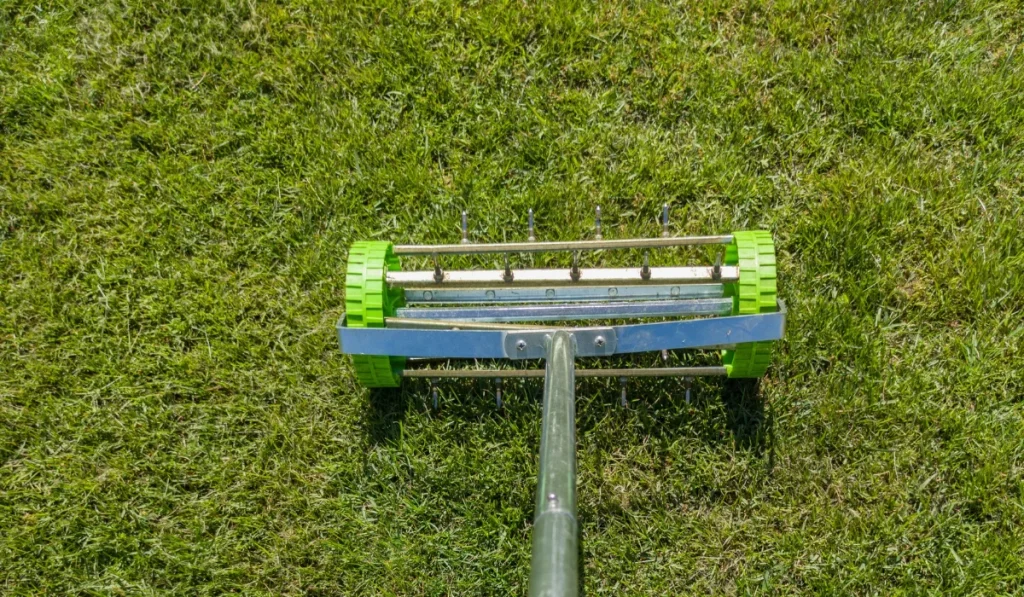
Core aeration removes small plugs of soil and creates openings in compacted areas. These holes can help water and air move into the root zone. Fertilizer applied during the same general maintenance period can support turf recovery when the grass is actively growing.
The UC IPM weed-management guide recommends aerating when turfgrass is actively growing. The UC Guide to Healthy Lawns also recommends fertilizing during active growth.
Use this simple decision process:
- Fertilize shortly after aeration when the lawn is actively growing, the turf needs nutrients, and irrigation is working correctly.
- Wait when the lawn is dormant, severely stressed, oversaturated, recently fertilized, or unable to absorb water without runoff.
- Adjust the plan when aeration is part of an overseeding or lawn-renovation project.
The goal is not to push rapid top growth. The goal is to support healthy turf recovery at the right time of year.
Why Aeration and Fertilizer Are Often Paired
Aeration and fertilization address different lawn problems.
Aeration helps reduce soil compaction. Compacted soil can limit the movement of oxygen, water, and nutrients into the root zone. Fertilizer supplies nutrients that support turf growth.
The two practices are often scheduled close together because a lawn recovering from compaction may benefit from better access to water and nutrients. However, fertilizer cannot replace aeration, and aeration does not correct every cause of thin grass.
A lawn may still struggle because of:
- Poor sprinkler coverage
- Mowing too low
- Heavy foot traffic
- Excess thatch
- Heat stress
- Drought stress
- Shade
- Poor drainage
- A turf variety poorly suited to the property
- Recent overfertilization
- Pest or disease issues
Inspect the lawn before adding fertilizer. A thin section caused by a broken sprinkler head needs irrigation repair first.
Know When Aeration Is Appropriate
Aeration is most useful when soil compaction interferes with lawn health.
The UC IPM lawn guide explains that compacted soil restricts oxygen, water, and nutrient movement around the roots. Lawns exposed to heavy traffic or growing in heavy clay soil may need aeration more frequently than lawns with little activity.
Signs of compaction include:
- Water pooling on the surface
- Runoff beginning quickly
- Hard soil
- Thin turf in high-traffic sections
- Grass growing slowly
- Bare patches near walkways
- Water failing to soak into the root zone
- Repeated weed problems
Core aeration removes small plugs of soil. These cores can remain on the lawn and break down naturally with irrigation.
Do not rake them away automatically. Once they dry and crumble, they return soil to the surface.
Match Fertilizer Timing to the Grass Type
Long Beach lawns can contain warm-season or cool-season turf. Each follows a different growth pattern.
Before fertilizing, identify the grass variety.
Warm-Season Grasses
Warm-season grasses grow most actively during warmer months.
The UC IPM Zone 9 warm-season fertilization guide recommends fertilizing warm-season grasses for the first time after they have fully greened up in spring and continuing during summer into fall.
Examples of warm-season turf include:
- Bermudagrass
- Hybrid Bermudagrass
- St. Augustinegrass
- Zoysiagrass
- Kikuyugrass
If a warm-season lawn has fully greened up and is actively growing, aeration and fertilizer may fit the same maintenance period.
Avoid pushing growth before the lawn has emerged from dormancy.
Cool-Season Grasses
Cool-season turf grows most actively during spring and fall.
The UC IPM Zone 9 cool-season fertilization guide recommends giving cool-season grasses most of their fertilizer during spring and fall while limiting applications during periods of high summer heat.
Examples include:
- Tall fescue
- Kentucky bluegrass
- Perennial ryegrass
- Fine fescue
A cool-season lawn aerated during mild weather may benefit from a carefully timed fertilizer application. A lawn struggling through a hot period may need a lighter approach or a delay.
Check Whether the Lawn Actually Needs Fertilizer
Aeration creates an opportunity to review the lawn. It does not prove that the turf lacks nutrients.
Before fertilizing, ask:
- When was the lawn last fertilized?
- Is the grass actively growing?
- Does the turf look pale or thin?
- Has irrigation coverage been checked?
- Is the soil compacted?
- Is the lawn under heat or drought stress?
- Are weeds taking over thin areas?
- Is the lawn newly installed?
- Are you overseeding after aeration?
- Does the product match the grass type?
A lawn that received fertilizer recently may not need another application.
Too much nitrogen can lead to soft, rapid growth, increased mowing, higher water demand, and greater vulnerability to certain lawn problems.
Use the Correct Nitrogen Rate
More fertilizer does not mean faster or healthier recovery.
The UC IPM fertilizer-amount guide recommends applying no more than one pound of actual nitrogen per 1,000 square feet during a single application.
UC IPM also recommends dividing the lawn’s fertilizer needs into smaller applications during the active growing season rather than adding large amounts less frequently.
To calculate the correct amount:
- Measure the lawn area.
- Read the fertilizer label.
- Find the nitrogen percentage in the N-P-K ratio.
- Follow the label’s rate instructions.
- Apply the product evenly.
- Sweep granules away from pavement.
- Water only as directed by the label.
For example, a product labeled 20-5-10 contains 20 percent nitrogen. The correct amount of product depends on the lawn area and the nitrogen rate you are applying.
Do not guess.
Choose Between Slow-Release and Quick-Release Nitrogen
The type of fertilizer affects how quickly nutrients become available.
Slow-Release Nitrogen
Slow-release fertilizer feeds the lawn gradually.
UC IPM notes that slow-release products may last up to eight weeks. They can be applied at six- to eight-week intervals during active growth.
Slow-release nitrogen may be useful when you want:
- More even growth
- A lower risk of fertilizer burn
- Fewer applications
- Less sudden top growth
- A steadier maintenance routine
Quick-Release Nitrogen
Quick-release fertilizer becomes available sooner.
UC IPM notes that quick-release products usually last around four to six weeks and may be applied at four- to six-week intervals during active growth.
Quick-release products require more precision. Applying too much can create uneven growth, stress the lawn, and increase watering needs.
For many home lawns, a slow-release product or a blend can provide a more manageable response.
Build a Safe Post-Aeration Fertilizer Routine
Use this process for an established lawn:
Step 1: Leave the Cores on the Lawn
Core aeration leaves small plugs of soil on the surface.
Let them dry and break down naturally. Irrigation, mowing, and normal lawn activity will gradually return the soil to the turf.
Step 2: Inspect Irrigation Coverage
Run each sprinkler zone before adding fertilizer.
Look for:
- Broken sprinkler heads
- Dry corners
- Overspray
- Water pooling
- Runoff
- Clogged nozzles
- Weak spray patterns
- Heads blocked by grass or soil
Fertilizer cannot correct uneven watering.
Step 3: Check the Weather
Avoid applying fertilizer immediately before heavy rain.
Rain or excessive irrigation can move nutrients away from the lawn and toward sidewalks, streets, and storm drains.
Step 4: Measure the Lawn
Calculate the square footage before opening the fertilizer bag.
For irregular lawns, divide the area into smaller rectangles or sections and add the totals together.
Step 5: Apply the Correct Amount
Use a spreader for even coverage.
Apply the product according to the label and avoid spreading granules onto hard surfaces.
Step 6: Sweep Pavement
Sweep fertilizer from sidewalks, patios, and driveways back onto the lawn.
Do not rinse granules into the street.
Step 7: Water Carefully
Follow the fertilizer label and Long Beach watering rules.
Stop before runoff begins.
Follow Long Beach Watering Rules
Long Beach has specific landscape-watering restrictions.
The Long Beach Utilities water-use restrictions page states that landscape watering is currently allowed on Tuesdays, Thursdays, and Saturdays only.
The city also requires residents to:
- Water before 9:00 a.m. or after 4:00 p.m.
- Water for no more than ten minutes per station per watering day, or until runoff begins, whichever occurs first
- Avoid watering during rainfall or within 48 hours afterward
- Prevent runoff onto sidewalks, streets, parking lots, structures, and neighboring properties
- Repair leaks and irrigation malfunctions
Check the city page before changing your schedule because local rules can change.
If a fertilizer product needs to be watered into the soil, plan the application around an approved watering day and stop the system when runoff begins.
Use Cycle-and-Soak Irrigation if Needed
Aerated soil may absorb water more effectively, but some sections can still produce runoff.
Compacted soil, slopes, and heavy clay areas may need shorter irrigation cycles.
Instead of running a station continuously:
- Run the sprinkler zone for a short period.
- Stop when runoff begins.
- Allow time for the water to soak into the soil.
- Run another short cycle later within the approved watering window.
- Stop when the lawn has received the required amount of water.
This approach can help move moisture into the root zone without sending fertilizer toward sidewalks and storm drains.
Avoid Fertilizing During Stressful Conditions
Delay fertilizer when the lawn cannot use the nutrients effectively.
Wait when:
- The lawn is dormant
- The turf is severely drought-stressed
- The soil is saturated
- Heavy rain is expected
- Runoff begins quickly
- The irrigation system is broken
- A heat wave is placing the lawn under stress
- The grass was fertilized recently
- The lawn shows signs of disease
- The turf has not recovered from major damage
The UC IPM fertilizer guide recommends applying nitrogen lightly and infrequently during drought conditions to avoid lush growth and reduce water demand.
A delay can be more useful than forcing the application into the wrong week.
Use Extra Care When Overseeding After Aeration
Aeration can create openings where seed reaches the soil more easily. This can make it useful during an overseeding project.
If you plan to overseed:
- Choose seed suited to the existing lawn
- Review the planting season
- Keep the seedbed moist without creating runoff
- Limit foot traffic
- Follow the seed and fertilizer labels
- Avoid products that could interfere with germination
A starter fertilizer may be appropriate during establishment when the product and soil conditions support its use.
Do not apply a weed-and-feed product automatically.
Some preemergence herbicides can prevent grass seed from establishing. Read the label before combining aeration, overseeding, fertilizer, and weed control.
Consider Weed Pressure After Aeration
Core aeration leaves temporary holes in the lawn.
UC IPM notes that some weed seeds may germinate in those openings. In a lawn with known weed problems, a preemergence herbicide may be considered after aeration.
However, that does not mean every lawn needs an herbicide.
UC IPM advises using combination fertilizer-and-herbicide products only when the lawn has a known weed problem and the timing is appropriate.
Avoid applying weed-control products automatically when:
- The lawn is healthy
- Only a few weeds are present
- You plan to overseed
- The product does not match the weed type
- The product is not approved for the turf variety
- The weather conditions are unsuitable
Hand-pulling isolated weeds may be enough.
Do Not Aerate New Sod Too Soon
New sod needs time to establish roots before it can handle aeration equipment.
Core aeration can tear or shift turf that has not anchored into the soil.
For a newly installed lawn:
- Keep the root zone moist during establishment
- Limit foot traffic
- Wait until the sod has rooted
- Mow carefully when the lawn is ready
- Begin the regular nitrogen routine at the appropriate time
- Avoid aeration until the turf is established
The UC IPM new-lawn care guide recommends beginning nitrogen fertilizer around six weeks after laying sod, sprigs, stolons, or plugs.
If an older lawn needs replacement, aerate and correct the soil before the new sod is installed.
Aerate Before Installing Replacement Sod
Aeration can be useful during a repair project when compacted soil contributed to lawn decline.
Before installing sod:
- Remove the damaged turf.
- Clear weeds, roots, and debris.
- Inspect the soil.
- Address compaction.
- Check drainage.
- Repair irrigation problems.
- Complete grading.
- Choose a turf variety suited to the property.
- Install fresh sod promptly.
- Follow the establishment watering plan.
SodLawn provides farm-fresh sod delivery and installation in Long Beach for residential and commercial properties.
Correcting the original lawn problem helps the new turf establish more evenly.
Avoid Common Post-Aeration Mistakes
Avoid these mistakes after core aeration:
- Fertilizing automatically without checking whether the lawn needs nutrients
- Adding too much nitrogen
- Applying fertilizer to dormant turf
- Fertilizing immediately before heavy rain
- Ignoring sprinkler problems
- Washing fertilizer off pavement with a hose
- Removing soil cores unnecessarily
- Running irrigation until runoff begins
- Using weed-and-feed products without identifying the weeds
- Applying preemergence herbicide before overseeding
- Aerating fresh sod before it has rooted
- Assuming every thin patch needs fertilizer
A short inspection can prevent unnecessary products and repeated lawn problems.
Build a Simple Post-Aeration Checklist
Use this checklist:
- Confirm that the grass is actively growing.
- Identify the turf variety.
- Check when the lawn was last fertilized.
- Leave soil cores on the lawn.
- Run each sprinkler zone.
- Repair leaks, overspray, and dry areas.
- Measure the lawn.
- Read the fertilizer label.
- Apply no more than the recommended nitrogen amount.
- Sweep granules from pavement.
- Water only as directed.
- Follow Long Beach watering rules.
- Stop before runoff begins.
- Monitor the lawn for recovery.
- Adjust the next maintenance step based on the results.
The right routine supports lawn recovery without adding unnecessary fertilizer or water.
Know When the Lawn Needs More Than Aeration
Aeration can improve compacted soil, but it cannot repair every turf problem.
A lawn may need a broader reset when:
- Bare areas continue spreading
- Irrigation coverage remains uneven
- Soil stays heavily compacted
- Drainage problems persist
- Weeds fill large sections
- The turf variety does not fit the site
- The lawn has repeated scalping damage
- Heat or drought stress has left large dead areas
- The existing grass no longer fills thin sections
Correct the cause before installing replacement turf.
A new lawn can struggle again when the same irrigation, grading, and mowing problems remain in place.
Refresh Your Long Beach Lawn With SodLawn
Aeration and fertilizer can help an established lawn recover when compaction and nutrient needs are addressed at the right time.
If the lawn has extensive bare or damaged areas, a larger renovation may provide a cleaner reset. SodLawn offers sod delivery and professional installation in Long Beach. Enter your ZIP code to compare sod varieties available near your Long Beach property and plan your lawn project.
Frequently Asked Questions
How Soon After Aeration Can I Fertilize?
You can usually fertilize during the same maintenance window, including shortly after core aeration, when the lawn is actively growing, needs nutrients, and can be watered without runoff. There is no universal waiting period.
Should I Fertilize Immediately After Aerating?
Not automatically. Check the grass type, season, lawn condition, recent fertilizer history, and weather first. A recently fertilized, dormant, or stressed lawn may need a delay.
Does Fertilizer Work Better After Aeration?
Aeration can improve the movement of water and nutrients into compacted soil. Fertilizer still needs to be applied at the correct rate and during active growth.
Should I Water After Fertilizing an Aerated Lawn?
Follow the fertilizer label. If watering is required, plan the application around Long Beach watering rules and stop before runoff begins.
What Days Can I Water My Lawn in Long Beach?
Long Beach Utilities currently allows landscape watering on Tuesdays, Thursdays, and Saturdays. Water before 9:00 a.m. or after 4:00 p.m.
Should I Remove Soil Cores After Aeration?
Usually not. Leave the cores on the lawn. They will dry, crumble, and break down naturally with irrigation and mowing.
Can I Overseed and Fertilize After Aeration?
Yes, when the seed, fertilizer, turf type, and season are compatible. Avoid preemergence herbicides that could interfere with seed germination.
Should I Use Weed-and-Feed After Aeration?
Do not use weed-and-feed automatically. Identify the weed problem first and confirm that the product fits the turf variety and timing. Avoid products that interfere with overseeding.
Can I Aerate New Sod?
Wait until the sod has established roots. Aerating too early can shift or tear fresh turf.
How Much Nitrogen Should I Apply After Aeration?
UC IPM recommends no more than one pound of actual nitrogen per 1,000 square feet in a single application. Follow the product label and adjust the rate to the lawn’s needs.