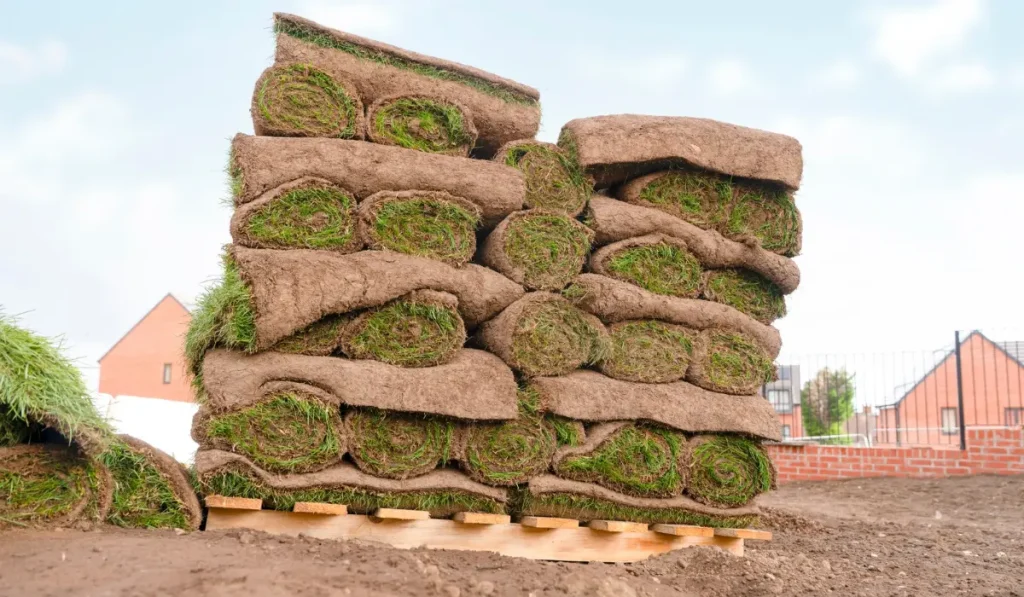
A pallet of sod can cover approximately 400 to 500 square feet, but this is a planning range, not a standard pallet size. Actual coverage varies by supplier, and some pallets may fall outside this range.
Based on these estimates, you’ll need 44 to 55 pallets for half an acre (21,780 square feet) or 88 to 109 pallets for a full acre (43,560 square feet), before overage. To calculate your order, measure the lawn area, confirm the supplier’s pallet coverage, and allow 5% to 10% extra for cutting waste.
How Many Square Feet Are in a Pallet of Sod?
A pallet of sod can cover approximately 400 to 500 square feet, but this is a planning range, not a standard pallet size. Actual coverage varies by supplier, grass product, slab or roll dimensions, and the number of pieces stacked on each pallet. Some suppliers may offer pallets outside this range.
For example, a 10,000-square-foot lawn requires 25 pallets if each covers 400 square feet, 23 pallets at 450 square feet, or 20 pallets at 500 square feet. These estimates exclude extra sod for cutting waste.
The 400- to 500-square-foot range is useful when preparing an initial estimate or comparing pallet quantities. However, it does not represent confirmed SodLawn pallet coverage. Before placing an order, verify the exact square footage for your selected grass product and use that figure in your final calculation.
How to Calculate Coverage From Sod Dimensions
If your supplier provides the dimensions and piece count, you can verify the total coverage yourself.
Square feet per piece × Number of pieces = Square feet per pallet
Suppose each slab measures 2 feet by 5 feet. That’s 10 square feet per slab, so a pallet containing 45 pieces covers 450 square feet.
For rolled sod, use the same calculation with the width and length of each roll. These dimensions are illustrative, so use your supplier’s actual measurements when calculating an order.
How Many Pallets of Sod Do You Need for a Half Acre?
A half acre contains 21,780 square feet. One acre equals 43,560 square feet under standard land-area measurements maintained by the National Institute of Standards and Technology’s Office of Weights and Measures.
The table shows the number of pallets needed to cover an entire half acre at three coverage rates, both with and without 10% overage.
| Coverage per Pallet | Half Acre | With 10% Overage |
| 400 sq ft | 55 pallets | 60 pallets |
| 450 sq ft | 49 pallets | 54 pallets |
| 500 sq ft | 44 pallets | 48 pallets |
All quantities are rounded up to whole pallets, with overage calculated before rounding.
Subtract Areas That Won’t Receive Sod
A half-acre lot contains 21,780 square feet, but not all of that space may need sod. Houses, driveways, patios, planting beds, and other permanent features should be excluded when calculating the installation area.
For example, suppose a half-acre property has 16,000 square feet of open lawn space. At 450 square feet per pallet, the calculation is:
16,000 ÷ 450 = 35.56 pallets
Rounded up, you’ll need 36 pallets before overage.
With 10% overage:
(16,000 × 1.10) ÷ 450 = 39.11 pallets
Rounded up, you’ll need 40 pallets with 10% overage.
By comparison, covering the entire half acre at the same pallet coverage requires 49 pallets before overage or 54 pallets with 10% overage.
Accurate sod ordering in California starts with measuring only the areas receiving grass. For properties with separate front yards, side strips, and backyard lawns, calculate each section and combine the totals before adding overage.
How Many Pallets of Sod Do You Need for an Acre?
A full acre contains 43,560 square feet. Depending on coverage, you’ll need 88 to 109 pallets before overage.
| Coverage per Pallet | Full Acre | With 10% Overage |
| 400 sq ft | 109 pallets | 120 pallets |
| 450 sq ft | 97 pallets | 107 pallets |
| 500 sq ft | 88 pallets | 96 pallets |
The difference between 400- and 500-square-foot pallets is 21 pallets for a full acre. This is why confirming coverage matters before finalizing a large order.
Why the Difference Matters on Large Jobs
An acre of commercial landscaping requires careful material planning. If you estimate using 500-square-foot pallets but receive pallets containing only 400 square feet, an 88-pallet order would leave 8,360 square feet uncovered before cutting waste.
Under-ordering can leave a crew without enough sod to finish the installation. Ordering too much creates excess material that still needs unloading, handling, and prompt installation.
Confirm the product’s coverage before placing the order, especially when coordinating multiple deliveries or scheduling a large installation crew.
Does Sod Variety Affect Square Feet per Pallet?
Grass variety alone doesn’t establish pallet coverage. Bermuda, Zoysia, St. Augustine, and Fescue sod may be harvested or packaged differently by different growers, so the same variety name doesn’t guarantee the same amount of sod.
When comparing drought-tolerant sod varieties for a California property, choose the grass based on the site’s growing conditions and maintenance requirements. Then use that product’s specific pallet coverage to determine how much to purchase.
Sod Slabs vs. Sod Rolls
Slabs are individual rectangular sections of turf. Rolls contain longer strips that installers unroll over prepared soil. Either format can cover the same total area, depending on the dimensions and quantity supplied.
For estimating, the square footage matters more than the piece count. A pallet containing 45 pieces doesn’t automatically cover 450 square feet unless each piece measures 10 square feet.
Cut format also affects handling. Larger sections may require different placement methods, while pallet weight depends partly on the amount of sod, soil thickness, and moisture content. Ask the supplier for the loaded weight if you’re arranging transportation or unloading equipment.
How Much Extra Sod Should You Order?
A 5% to 10% overage is a practical starting point for sod estimates. The allowance accounts for pieces trimmed along borders, around planting beds, and beside walkways.
A rectangular lawn with long, straight edges may need less cutting than a layout with curves, narrow strips, and multiple obstacles. For the simpler job, consider a 5% allowance. For an irregular layout, 10% may be more appropriate.
These percentages aren’t guaranteed waste rates. If you’re working with unusual shapes or extensive trimming, assess the layout before settling on the final quantity.
Avoid Buying More Than the Crew Can Install
Extra sod has a cost beyond the purchase price. It must be delivered, unloaded, and handled, even if the installation is nearly complete.
Fresh sod can deteriorate while stacked, especially under hot conditions. Arrange delivery for when the ground is ready and the crew can begin laying it. For larger jobs, discuss delivery scheduling with your supplier rather than assuming every pallet must arrive at once.
When purchasing by the pallet, always round the final estimate up to a whole number. There’s no need to add another pallet after rounding unless the job requires a larger overage allowance.
How to Calculate Your Sod Order
Use your net installation area, the supplier’s confirmed pallet coverage, and the appropriate overage allowance to estimate the number of pallets needed.
Pallets needed = (Net installation area × Overage multiplier) ÷ Square feet per pallet
Use 1.05 for 5% overage, 1.08 for 8%, or 1.10 for 10%. Round the final result up to a whole pallet.
Step 1: Measure Each Lawn Section
For rectangular areas, multiply length by width. A lawn measuring 40 feet by 60 feet contains 2,400 square feet.
If the property includes separate lawn sections, calculate each one and combine the totals. For irregular spaces, divide the layout into smaller measurable shapes instead of estimating the entire area by eye.
Exclude permanent surfaces such as buildings, concrete paths, patios, and planting beds. The resulting total is your net installation area.
Step 2: Calculate the Pallets With Overage
Consider a 12,000-square-foot residential property where buildings, paved surfaces, and planting beds occupy 1,500 square feet.
That leaves 10,500 square feet for sod. If each pallet covers 450 square feet and the lawn requires 8% overage, the calculation is:
(10,500 × 1.08) ÷ 450 = 25.2 pallets
Round up to 26 pallets.
This calculation accounts for the measured lawn area, the selected overage, and the supplier’s coverage.
Common Sod Ordering Mistakes to Avoid
Most quantity errors start before anyone begins laying grass. The wrong measurement, an assumed pallet size, or an incomplete installation schedule can affect the entire order.
Measuring the Lot Instead of the Lawn
Property acreage includes spaces where sod won’t be installed. Using the gross lot size can significantly overstate the material required.
Measure the sections that need grass and subtract permanent obstacles. For commercial properties with parking areas, pedestrian paths, and planting islands, this distinction is especially useful.
Using a Pallet Count From Another Project
A previous job may have used different sod dimensions or a different supplier. Reusing that pallet count without checking the coverage can produce a shortage or an unnecessarily large order.
Compare products by total square footage, not just the number of pallets. If you’re evaluating supplier prices, calculate the cost per square foot to make the comparison more meaningful.
Underestimating Cuts Around Obstacles
Straight runs generally require fewer cuts than curved beds, narrow side yards, and lawns interrupted by walkways.
Small offcuts can sometimes be reused, but not every piece will fit another section. Review the layout before choosing between a lower or higher overage allowance.
Scheduling Delivery Before Grading Is Complete
The installation area should be prepared before the sod arrives. Uneven soil can leave low areas or interfere with consistent contact between the sod and the ground.
An uneven California lawn may require grading or leveling before installation. Addressing these conditions before delivery avoids having a crew and fresh sod on-site while preparation is still underway.
The University of California Agriculture and Natural Resources turfgrass information provides California-focused guidance on turfgrass management and establishment.
Forgetting About Truck Access and Unloading
A large pallet order doesn’t guarantee a single truckload. Vehicle payload limits, loaded pallet weights, and available unloading equipment determine what can be transported safely.
Site access matters as well. A truck serving a large residential property may face different access conditions from one delivering to an open commercial landscape.
Account for sod delivery costs in California when preparing the project budget. Provide the supplier with the planned pallet count, delivery location, and any restrictions affecting truck access.
Order the Right Amount of Sod for Your California Project
Measure your lawn, account for cutting waste, and divide the adjusted area by the supplier’s confirmed pallet coverage. Round up to whole pallets to get the quantity you need. The half-acre and full-acre tables above provide a starting point, while the formula works for any measured installation area.
Have your measurements and installation schedule ready before requesting a quote. The supplier can confirm actual pallet coverage and discuss delivery arrangements for the quantity required.
Browse SodLawn’s sod and lawn care products for your California installation, or contact the SodLawn team with your net square footage, preferred grass, and delivery location to request a pallet-count quote.