A circle or curved line of mushrooms can appear suddenly in a Long Beach lawn after irrigation, damp weather, or a change in soil conditions. The mushrooms may look alarming, but they do not always mean that the grass is diseased or dying.
The actual origin of these mushroom rings lies within the soil beneath the grass. Mushrooms are the visible fruiting bodies of fungi growing in the soil. Some fungi help break down buried organic matter and do little harm to turf.
Others create fairy rings that may change grass color, interfere with water penetration, or leave thin and damaged areas. The right response depends on what the lawn looks like around the ring.
Key Takeaways
- Mushroom rings may come from beneficial fungi breaking down organic matter in the soil.
- A ring of mushrooms does not automatically mean the lawn is diseased.
- Fairy rings may appear as mushrooms, darker green grass, brown turf, or a combination of symptoms.
- Buried wood, dead roots, excess thatch, overirrigation, and poor drainage can contribute to mushroom growth.
- Remove visible mushrooms promptly when children or pets use the yard.
- Do not eat wild lawn mushrooms or rely on appearance alone to decide whether they are safe.
- Follow Long Beach watering rules and stop irrigation before runoff begins.
- Improve drainage and water penetration before replacing damaged turf.
- Aeration and dethatching may help in some cases.
- Severe or persistent fairy-ring damage may require lawn renovation and fresh sod.
What Are Mushroom Rings?
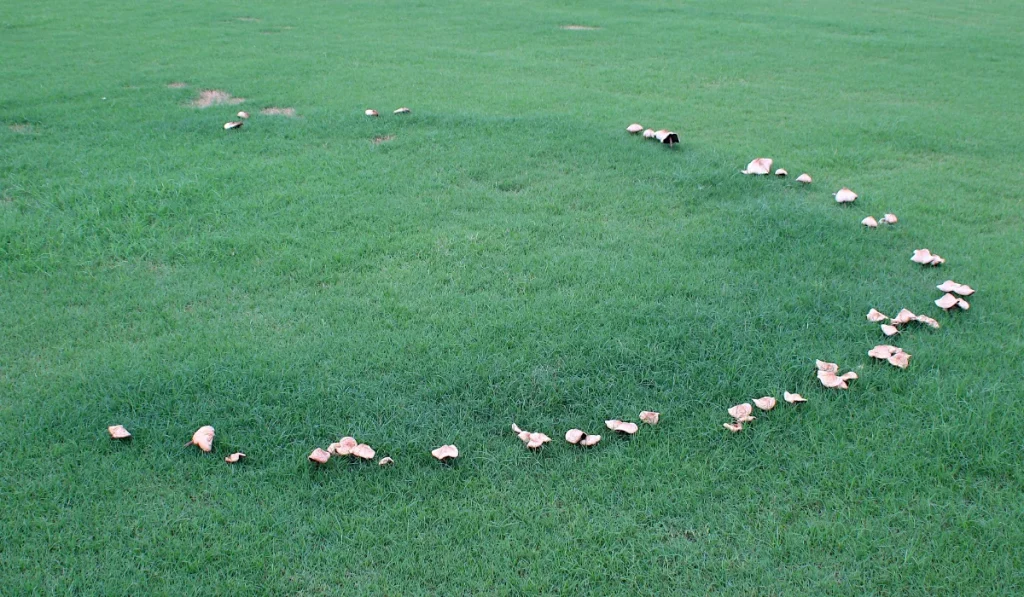
Mushroom rings are circular or semicircular patterns that appear in turf. The pattern may include visible mushrooms, a darker green band of grass, a brown ring, or a patch of thinning turf.
The UC IPM guide to mushrooms and nuisance fungi in lawns explains that fungal spores can settle in favorable areas and develop threadlike structures called hyphae. Groups of hyphae form an underground mass known as mycelium.
When conditions support growth, the fungus produces visible fruiting bodies. These are the mushrooms that appear above the grass.
Removing the mushrooms improves the appearance of the lawn and can reduce access for children and pets. It does not remove the underground fungal network automatically.
Are Mushroom Rings the Same as Fairy Rings?
Some mushroom circles are fairy rings, but not every lawn mushroom pattern causes the same level of damage.
Fairy rings form when certain fungi expand outward through the soil. The fungi may create circular or curved patterns as they grow.
The UC IPM fairy-ring guide explains that fairy-ring symptoms vary. A lawn may develop:
- A circular or semicircular band of dark green turf
- A ring of brown or dying grass
- Visible mushrooms
- White fungal growth beneath the thatch
- A combination of these symptoms
All turfgrass species can develop fairy rings.
The lawn condition matters more than the presence of mushrooms alone. A few mushrooms with healthy surrounding grass may be a cosmetic issue. A ring associated with declining turf and poor water absorption needs closer attention.
Why Mushroom Rings Show Up in Long Beach Lawns
Mushrooms often appear when underground fungi have access to organic material and enough moisture to produce visible fruiting bodies.
Several factors can contribute.
Buried Wood or Old Tree Roots
Mushrooms may grow where fungi are decomposing organic matter beneath the lawn.
Common sources include:
- Old tree roots
- Buried wood
- Construction lumber scraps
- Decaying stumps
- Organic debris left in the soil
- Older root systems beneath renovated lawns
UC IPM notes that these fungi often help decompose organic matter and return nutrients to the soil.
If mushrooms appear in the same small area repeatedly, check whether the lawn sits near a removed tree, an old stump, or a section of the yard that was previously landscaped.
Moist Soil After Irrigation
Fungi can survive in the soil for years and produce mushrooms when conditions become favorable.
Moisture is a common trigger. UC IPM notes that mushrooms often appear after prolonged wet conditions and may also be associated with overirrigation or poor soil drainage.
In Long Beach, this does not mean that the solution is to stop watering the lawn entirely. The better approach is to inspect the irrigation system, reduce unnecessary moisture, and follow local watering rules.
Excess Thatch
Thatch is the layer of stems, roots, and organic material that develops between the green grass and the soil surface.
A thin layer can be normal. A thick layer may hold moisture, reduce water movement, and create conditions that support nuisance fungi.
UC IPM recommends dethatching when the layer exceeds half an inch.
Poor Drainage
A lawn that stays wet long after irrigation stops may provide favorable conditions for mushrooms.
Poor drainage can result from:
- Compacted soil
- Clay-heavy soil
- Low spots
- Uneven grading
- Broken sprinkler heads
- Overlapping sprinkler coverage
- Long irrigation cycles
- Water flowing downhill
- Excess thatch
- Soil layers that slow water movement
Fixing the drainage issue can help the lawn and reduce repeat mushroom growth.
New Sod Establishment
Mushrooms can also appear shortly after new sod is installed.
Fresh sod needs frequent moisture while roots develop. That temporary watering routine can create favorable conditions for mushrooms.
UC IPM notes that mushrooms in newly laid sod are generally harmless to the grass and often disappear after irrigation frequency is reduced as the lawn becomes established.
Do not reduce watering too quickly simply because mushrooms appear. Follow the establishment instructions for the turf variety and adjust gradually as roots develop.
Read the Lawn Pattern Before Taking Action
The appearance of the lawn around the mushrooms can help you decide what to do next.
Mushrooms With Otherwise Healthy Grass
If the turf remains dense and evenly colored, the mushrooms may be a nuisance rather than a serious lawn problem.
Remove the visible mushrooms and monitor the area.
Check whether irrigation, drainage, or buried organic matter may be contributing to repeat growth.
A Dark Green Ring
A darker green circle may form when fungal activity releases nutrients into the soil.
The grass inside the ring may grow faster or appear more vibrant than the surrounding lawn.
This pattern can be unsightly, but it does not always mean the grass is dying.
A Brown or Thinning Ring
A brown ring needs more attention.
In some fairy rings, fungal growth creates a dense underground layer that makes it harder for water to enter the soil. The grass may become stressed because moisture is not reaching the roots evenly.
Look for:
- Brown turf
- Dry soil beneath the surface
- Water running away from the ring
- Thin grass
- Bare areas
- Weeds filling open soil
- White, cottony fungal growth beneath the thatch
When the grass is declining, focus on improving water penetration and diagnosing the fungal mat before patching the lawn.
Mushrooms in a Newly Installed Lawn
New sod can produce mushrooms even when the turf is establishing normally.
Inspect the lawn for:
- Root development
- Moisture level
- Runoff
- Soft or muddy soil
- Open seams
- Uneven sprinkler coverage
- Mushrooms near edges or low spots
If the sod is rooting well and the lawn is not saturated, remove the mushrooms and continue the establishment routine.
Remove Visible Mushrooms Safely
Visible mushrooms can be removed even when the underlying fungus remains in the soil.
Pick or rake them soon after they appear. Dispose of them where children and pets cannot reach them.
UC IPM recommends removal primarily for appearance and safety. Some wild mushrooms are poisonous, and there is no simple visual test that reliably separates edible mushrooms from toxic ones.
Use these precautions:
- Wear gloves when collecting mushrooms.
- Keep children away from the area until mushrooms are removed.
- Prevent pets from eating mushrooms.
- Place collected mushrooms in a closed waste container.
- Avoid tasting or cooking wild mushrooms.
- Do not rely on color, size, or shape to decide whether a mushroom is safe.
- Check the lawn again after irrigation or damp weather.
If a child or pet may have eaten a wild mushroom, contact an appropriate medical or veterinary professional promptly.
Check the Irrigation System
Mushroom rings can reveal an irrigation problem.
Run each zone separately and watch the lawn.
Look for:
- Water pooling around one sprinkler head
- Overspray onto sidewalks
- Water reaching the curb
- Broken sprinkler heads
- Clogged nozzles
- Water bubbling from below the surface
- Low spots
- Soft or muddy soil
- Dry patches beside wet areas
- Overlapping sprinkler patterns
A section with too much water may need a sprinkler adjustment rather than a longer runtime across the full lawn.
Follow Long Beach Watering Rules
Long Beach has specific outdoor-watering restrictions.
The Long Beach Utilities water-use restrictions page states that landscape watering is currently allowed on Tuesdays, Thursdays, and Saturdays only.
The city also requires residents to:
- Water for no more than ten minutes per station per watering day, or until runoff begins, whichever occurs first
- Water before 9:00 a.m. or after 4:00 p.m.
- Avoid watering during rainfall or within 48 hours afterward
- Prevent runoff onto neighboring properties, sidewalks, roadways, parking lots, and structures
- Repair leaks and other water-wasting malfunctions
Check the city page before changing the irrigation schedule because local rules can change.
Reducing unnecessary moisture can help discourage repeat mushroom growth while protecting the lawn and preventing runoff.
Use Shorter Irrigation Cycles When Needed
A long irrigation cycle may leave one section of the lawn saturated while another remains dry.
Use cycle-and-soak irrigation when water begins pooling or moving toward pavement.
For example:
- Run one sprinkler zone.
- Stop when runoff begins.
- Allow time for water to soak into the soil.
- Run another short cycle later within the approved watering window.
- Stop when the lawn has received enough water.
The right timing depends on the turf type, soil, slope, sprinkler output, and season.
Do not continue watering simply because the controller has more time remaining.
Improve Water Penetration
A fairy ring can sometimes interfere with water movement beneath the lawn.
UC IPM recommends checking the depth of the fungal mat when grass inside the ring becomes stressed. A trowel, shovel, or long screwdriver can help reveal whether dense white fungal growth sits beneath the thatch.
When the affected layer is shallow, core aeration may help improve water penetration.
Mark Sprinkler Heads First
Before aerating:
- Run each irrigation zone.
- Place landscape flags beside sprinkler heads.
- Mark valve boxes.
- Note drip lines near lawn edges.
- Check for drainage grates.
- Remove rocks, toys, and other debris.
- Review the marked areas before using equipment.
Aeration equipment can damage irrigation components that are difficult to see.
Use Core Aeration
A core aerator removes small plugs of soil.
For general compaction, soil cores can usually remain on the lawn and break down naturally. When aerating specifically to manage a fairy ring, follow the UC IPM fairy-ring guidance carefully because affected cores may need to be collected and removed rather than spread across healthy turf.
If the fungal mat appears deep or the lawn damage is extensive, ask a lawn-care professional to evaluate the area before digging.
Check the Thatch Layer
Thick thatch can contribute to moisture problems and support fungal activity.
To inspect the lawn:
- Cut a small wedge from the turf.
- Look between the grass blades and soil.
- Measure the layer of stems, roots, and organic material.
- Compare the result across several areas.
If the thatch layer exceeds half an inch, dethatching may help.
Avoid aggressive dethatching when the lawn is under heat stress, drought stress, or another active problem.
Do Not Treat Every Mushroom Ring With Fertilizer
A dark green ring may make the surrounding lawn look pale by comparison. That does not automatically mean the full lawn needs more fertilizer.
Fertilizer decisions should reflect:
- Grass type
- Season
- Recent fertilizer history
- Lawn condition
- Soil needs
- Irrigation coverage
- Local watering limitations
- Product-label instructions
UC IPM notes that adequate nitrogen may help mask some fairy-ring symptoms. However, overfertilizing can increase mowing needs, water demand, and lawn stress.
Measure the lawn and follow the product label. Do not add fertilizer directly to a mushroom ring as a quick fix.
Avoid DIY Lawn Remedies
Online advice for mushrooms often includes household products that can damage turf or soil.
Avoid pouring these materials onto the lawn:
- Bleach
- Salt
- Concentrated vinegar
- Dish soap
- Household cleaners
- Baking soda mixtures
- Unlabeled chemical combinations
- Boiling water
These products may burn grass, alter soil conditions, or create runoff.
Removing visible mushrooms, correcting irrigation, improving drainage, and addressing thatch are safer first steps.
Fungicides Are Not the First Step
A mushroom ring does not automatically need fungicide.
UC IPM notes that fungicides have not been observed to reliably control fairy rings in home lawns. Effective treatment can require careful timing, repeated applications, and products that may not be readily available to home gardeners.
Start with cultural practices:
- Remove visible mushrooms.
- Inspect irrigation.
- Correct runoff.
- Improve water penetration.
- Aerate when appropriate.
- Dethatch when needed.
- Repair drainage problems.
- Remove buried organic material when practical.
- Renovate dead sections if necessary.
If the lawn continues declining, ask a lawn-care professional to inspect the area.
Remove Buried Organic Material When Practical
Some mushrooms return because fungi are breaking down buried wood or roots.
If a small, accessible section contains old wood:
- Remove the visible mushrooms.
- Identify the source when possible.
- Dig out the buried material carefully.
- Remove loose organic debris.
- Refill the area with clean soil.
- Repair the turf.
Avoid digging blindly across the lawn.
If the area contains irrigation components, tree roots, or buried utilities, ask a professional to inspect the site first.
Know When Renovation May Be Needed
A cosmetic ring does not require a full lawn replacement.
Renovation becomes more relevant when:
- Grass inside the ring has died
- Water no longer penetrates the soil evenly
- Bare areas keep expanding
- Weeds fill the open soil
- The fungal mat is dense and deep
- Aeration does not improve the area
- Drainage problems remain unresolved
- The lawn contains several overlapping damaged sections
- Sod replacement is already part of a broader renovation plan
UC IPM notes that dead areas in bunch-type grasses may need reseeding. Creeping grasses may fill small sections gradually when growing conditions improve.
Correct the cause before installing replacement sod. New turf can struggle again if drainage, irrigation, or soil problems remain unchanged.
Replace Severely Damaged Turf Only After Site Preparation
Fresh sod can restore a damaged section after the underlying problem has been addressed.
Before installing replacement turf:
- Remove dead grass.
- Check the depth of the affected soil.
- Improve drainage.
- Remove buried wood when practical.
- Break up compacted soil.
- Correct irrigation coverage.
- Repair leaks and overspray.
- Add clean soil when needed.
- Complete the final grade.
- Choose a turf variety suited to the property.
- Install sod promptly.
- Follow the establishment watering plan.
SodLawn provides sod delivery and professional installation in Long Beach for residential and commercial lawn projects.
The local page allows customers to enter a ZIP code and compare sod varieties available near the property.
Watch New Sod Carefully
New sod needs frequent moisture while roots develop. That temporary routine can also support mushroom growth.
During establishment:
- Remove mushrooms as they appear.
- Keep pets and children away from visible fungi.
- Check the soil moisture.
- Avoid saturated conditions.
- Watch for runoff.
- Inspect sod seams.
- Look for dry edges.
- Test sprinkler coverage.
- Reduce irrigation frequency gradually as the lawn roots.
- Follow local watering rules and any applicable establishment guidance.
Mushrooms alone do not mean the new sod is failing.
The more important questions are whether the lawn is rooting, whether water drains properly, and whether the turf remains healthy.
Keep Children and Pets Safe
Wild mushrooms should not be treated as harmless simply because they grew in a lawn.
UC IPM warns that many mushroom species are poisonous and that only an expert can distinguish edible varieties from toxic ones reliably.
Use a simple safety routine:
- Inspect the lawn before children or pets enter the yard.
- Remove mushrooms promptly.
- Check the area again after damp conditions or irrigation.
- Dispose of mushrooms securely.
- Keep pets away from repeat-growth areas.
- Do not encourage children to touch or taste wild fungi.
- Seek medical or veterinary guidance promptly if ingestion may have occurred.
Safety matters even when the mushrooms are not damaging the grass.
Avoid Common Mushroom-Ring Mistakes
Avoid these mistakes:
- Assuming every mushroom means the lawn is diseased
- Ignoring mushrooms when pets or children use the yard
- Eating wild lawn mushrooms
- Increasing irrigation without checking soil moisture
- Running sprinklers until runoff begins
- Applying fertilizer automatically
- Pouring household remedies onto the grass
- Using fungicide as the first response
- Aerating without marking sprinkler heads
- Leaving thick thatch unaddressed
- Installing sod over unresolved drainage problems
- Replacing turf without checking for buried wood or roots
- Reducing new-sod watering too quickly because mushrooms appear
A careful diagnosis prevents unnecessary products and repeated lawn problems.
Build a Simple Mushroom-Ring Checklist
Use this checklist:
- Remove visible mushrooms promptly.
- Keep children and pets away from the area.
- Check whether the grass remains healthy.
- Look for a dark green ring, brown band, or thinning turf.
- Run each sprinkler zone separately.
- Correct leaks, overspray, and pooling.
- Follow Long Beach watering rules.
- Reduce unnecessary irrigation.
- Inspect the thatch layer.
- Check soil drainage.
- Look for buried wood or old tree roots.
- Aerate carefully when poor water penetration contributes to the problem.
- Remove affected cores when managing a diagnosed fairy ring.
- Avoid household remedies.
- Ask a professional for help when the fungal mat appears deep or the turf keeps dying.
- Repair damaged sections only after correcting the underlying issue.
Know When To Call a Lawn-Care Professional
Professional evaluation may help when:
- The lawn develops a widening brown ring
- Water does not enter the soil inside the ring
- The fungal mat appears deep
- Mushrooms return repeatedly in the same area
- The yard contains several damaged rings
- Drainage remains poor
- The area sits near irrigation lines or tree roots
- A large section needs soil removal
- The lawn requires grading
- Replacement sod installation is planned
- The cause remains unclear after basic maintenance
A professional can help determine whether the lawn needs irrigation repair, aeration, dethatching, soil removal, drainage correction, or a larger renovation.
Refresh Your Long Beach Lawn With SodLawn
Many mushroom rings are temporary nuisance problems. When the turf remains healthy, removing visible mushrooms and correcting moisture issues may be enough.
If a fairy ring has left large bare or damaged sections, restore the soil conditions before installing replacement turf. SodLawn offers sod delivery and professional installation in Long Beach. Enter your ZIP code to compare sod varieties available near your property and plan your lawn repair.
Frequently Asked Questions
What Causes Mushroom Rings in a Lawn?
Mushroom rings often develop when fungi grow through soil and decompose organic matter such as buried wood or old tree roots. Moist conditions, poor drainage, overirrigation, and excess thatch can also contribute.
Are Mushroom Rings Bad for Grass?
Not always. Some mushrooms are nuisance fungi that do little harm to turf. Fairy rings can sometimes create darker grass bands, reduce water penetration, or contribute to brown and dying areas.
Should I Remove Lawn Mushrooms?
Yes, especially when children or pets use the yard. Removing mushrooms improves the lawn’s appearance and reduces the risk of accidental ingestion. It does not remove the underground fungus automatically.
Are Lawn Mushrooms Poisonous?
Some wild mushrooms are poisonous. UC IPM warns that only an expert can reliably distinguish edible and poisonous species. Do not eat wild lawn mushrooms and remove them before children or pets use the yard.
Why Do Mushrooms Appear After Watering?
Moist conditions can support visible mushroom growth. Fungi may live in the soil for years and produce mushrooms when moisture and other conditions become favorable.
Do Mushrooms Mean I Am Overwatering My Lawn?
Not necessarily. However, mushrooms can be associated with overirrigation or poor drainage. Check the soil moisture, sprinkler coverage, and runoff before changing the watering schedule.
What Is a Fairy Ring?
A fairy ring is a circular or semicircular lawn pattern caused by certain fungi. The pattern may include mushrooms, a darker green band of grass, brown turf, or a combination of symptoms.
Can Aeration Help With Fairy Rings?
Aeration may help when a shallow fungal mat interferes with water penetration. Mark sprinkler heads first and follow the appropriate process for removing affected cores. Ask a professional for help when the fungal layer appears deep.
Do Fungicides Eliminate Fairy Rings?
UC IPM notes that fungicides have not been observed to reliably control fairy rings in home lawns. Cultural practices such as moisture management, aeration, dethatching, and renovation are often more practical first steps.
Can Mushrooms Appear in New Sod?
Yes. New sod often needs frequent watering while roots establish, creating favorable conditions for mushrooms. They are generally harmless to the grass and often disappear as irrigation frequency is reduced gradually.
When Should I Replace Grass Damaged by a Fairy Ring?
Replace turf after correcting the cause. Large dead areas, poor water penetration, deep fungal mats, and unresolved drainage problems may require soil preparation and fresh sod.