Choosing between slow-release and quick-release nitrogen can affect how evenly your Palm Springs lawn grows, how often you need to fertilize, and how carefully you need to manage irrigation afterward.
For most established lawns, slow-release nitrogen is the safer default. It provides nutrients gradually, supports steadier growth, and reduces the risk of leaching. Quick-release nitrogen can still be useful when a lawn needs a faster response, but it requires more precise timing and application.
The best choice depends on your grass type, the condition of the lawn, the season, and whether you are caring for established turf or recently installed sod.
Key Takeaways
- Slow-release fertilizers feed your lawn over an extended period.
- Quick-release fertilizer gives fast green-up but needs frequent applications.
- Hot climates favor slow-release options for better results.
- Too much quick-release fertilizer can cause fertilizer burn and runoff.
- Choosing the right fertilizer supports a healthy lawn.
What Nitrogen Does for a Lawn
Nitrogen supports green leaf growth and helps turf maintain a dense appearance. A lawn that does not receive enough nitrogen may look pale, thin, or slow-growing. A lawn that receives too much can grow rapidly, require more mowing, and become more difficult to manage.
The UC IPM lawn-fertilizing guide explains that nitrogen is the nutrient turfgrass needs regularly. Phosphorus and potassium may also matter, but they should not be added automatically without considering the needs of the lawn and soil.
Fertilizer is not a cure-all. A lawn may remain yellow or patchy because of uneven irrigation, compacted soil, mowing damage, disease, or poor turf selection. Before increasing the nitrogen rate, inspect the lawn for other causes.
Slow Release vs Quick Release Nitrogen: The Main Difference
The difference comes down to how quickly nitrogen becomes available to the grass.
Slow-release nitrogen feeds the lawn over time. Quick-release nitrogen becomes available more rapidly after application. Both can support healthy turf when applied correctly, but they create different maintenance demands.
Slow-Release Nitrogen
Slow-release fertilizer is designed to provide nutrients gradually. Some fertilizer labels identify the slow-release portion as water-insoluble nitrogen, often abbreviated as WIN.
The UC Guide to Healthy Lawns explains that water-insoluble nitrogen releases over time and can continue supplying nutrients for eight to ten weeks or longer, depending on the product. The response is slower than with quick-release fertilizer, but the feeding period lasts longer.
Slow-release nitrogen works well when you want:
- More even lawn color
- Steadier growth
- Fewer fertilizer applications
- Less risk of leaching
- A lower chance of fertilizer burn
- Less sudden top growth during hot weather
This gradual response can be especially useful in Palm Springs, where fertilizer and irrigation need to work together carefully during warm periods.
Quick-Release Nitrogen
Quick-release fertilizer is water-soluble and becomes available to the grass sooner. It can create a faster visible response when the lawn is actively growing and genuinely needs nitrogen.
The UC IPM fertilizer frequency guide notes that quick-release fertilizers typically last around four to six weeks. Slow-release products may last up to about eight weeks, depending on their formulation.
Quick-release nitrogen may make sense when:
- An established lawn needs a faster correction
- The application rate can be measured accurately
- Irrigation is working evenly
- The grass is actively growing
- You can monitor the lawn closely after application
Quick-release fertilizer requires more care. Excess nitrogen can lead to uneven growth, yellow or brown patches, and unnecessary water use.
Which Option Is Better for Palm Springs Lawns?
For routine maintenance, slow-release nitrogen is usually the more practical choice. Palm Springs lawns face periods of high heat and increased irrigation demand. A fertilizer that feeds gradually makes it easier to support steady growth without pushing the lawn too hard.
Quick-release nitrogen is better treated as a targeted option rather than the automatic choice for every application.
A blended product can also be useful. Some fertilizers combine quick-release nitrogen for an initial response with slow-release nitrogen for continued feeding. The UC lawn guide notes that an effective mixed product should include at least one-quarter of its nitrogen in a slow-release form.
The right product still depends on the lawn. Read the fertilizer label, confirm the grass type, and avoid assuming that a faster green-up always means better long-term results.
Palm Springs Heat Changes the Fertilizer Strategy
Palm Springs lawn care requires close attention to temperature, soil moisture, and irrigation performance. Nitrogen can encourage new growth, but that growth also needs water.
Applying fertilizer heavily during drought stress or extreme heat can create more work for the lawn. UC IPM recommends applying nitrogen lightly and infrequently under drought conditions to avoid excessive growth and reduce water use.
The City of Palm Springs encourages residents and businesses to check sprinkler systems before the hot summer months. Its guidance recommends inspecting hard surfaces for overspray, adjusting irrigation duration, repairing damaged lines, cleaning sprinkler heads, and minimizing watering during the hottest part of the day.
Before applying nitrogen, walk through the yard and check for:
- Dry patches
- Water pooling on the soil
- Runoff moving toward sidewalks or streets
- Sprinkler heads with weak or uneven flow
- Brown sections caused by missed coverage
- Areas that stay wet longer than the rest of the lawn
Fertilizing a lawn with uneven irrigation can make the contrast more visible. Well-watered areas may grow quickly while dry sections remain weak.
Adjust Irrigation Throughout the Year
Palm Springs lawns do not need the same watering schedule in every season. The Desert Water Agency watering guide recommends adjusting irrigation monthly to reflect changing conditions. It also advises turning sprinklers off for at least 48 hours after rain.
Fertilizer application should match that seasonal rhythm. Apply nitrogen only when the grass is actively growing and the irrigation system can deliver water evenly.
After applying fertilizer:
- Sweep granules off sidewalks, driveways, and other hard surfaces
- Return spilled fertilizer to the lawn rather than washing it into the street
- Water only enough to move the product from the grass blades into the soil
- Avoid overwatering and runoff
- Check the lawn during the following days for uneven color or stressed patches
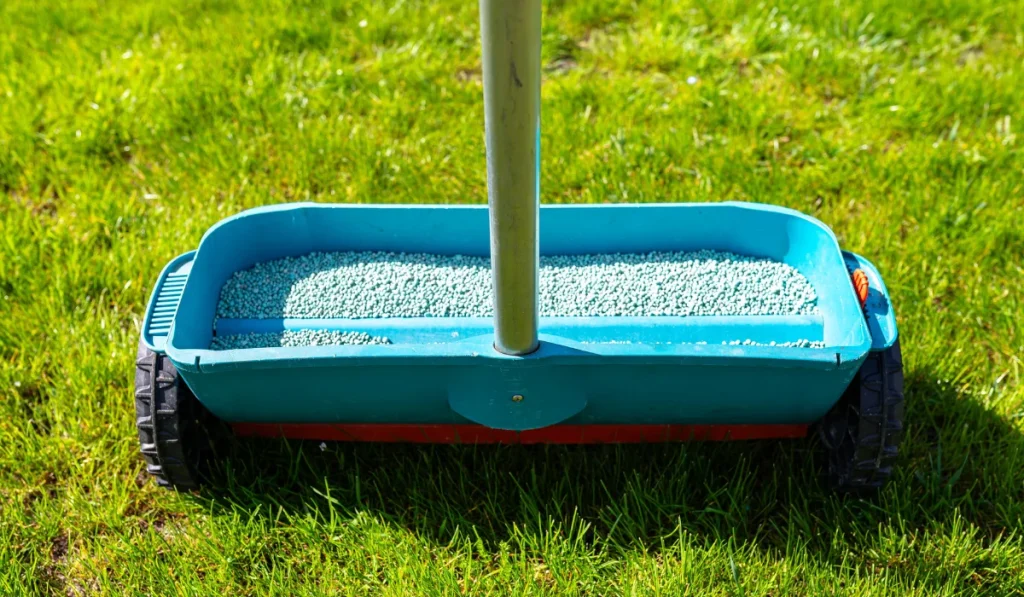
UC IPM recommends using a drop spreader rather than a rotary spreader when possible because it offers better control and reduces off-target application.
Match the Fertilizer to the Grass Type
Palm Springs properties may have warm-season grasses, cool-season grasses, or overseeded lawns. Each one follows a different growth pattern.
Warm-season grasses, including Bermudagrass and St. Augustinegrass, grow most actively during warmer months. Cool-season grasses, including tall fescue, respond differently and may struggle more during intense summer heat.
SodLawn’s Palm Springs sod delivery and installation page lists several varieties available locally, including TifTuf, St. Augustine, and other options that vary by ZIP code and season.
Before choosing a fertilizer schedule, identify the grass type. A product that fits a warm-season Bermudagrass lawn may not be the right option for a fescue lawn or an overseeded winter lawn.
How Much Nitrogen Should You Apply?
More nitrogen does not automatically produce a healthier lawn.
The UC IPM lawn-fertilizing guide recommends applying no more than one pound of actual nitrogen per 1,000 square feet during a single application. The correct amount depends on the turf species, the product formulation, and the condition of the lawn.
Actual nitrogen is different from the total weight of the fertilizer bag. The first number in the N-P-K ratio shows the percentage of nitrogen in the product.
For example, a fertilizer labeled 20-5-10 contains 20 percent nitrogen. You need to calculate the product amount based on that percentage and the square footage of the lawn.
Before spreading fertilizer:
- Measure the lawn area.
- Read the fertilizer label carefully.
- Calculate the amount of actual nitrogen.
- Confirm that the grass is actively growing.
- Check irrigation coverage.
- Apply the product evenly.
- Sweep fertilizer away from pavement.
Avoid increasing the rate because the lawn looks stressed. Yellow or thin grass may have an irrigation, soil, or maintenance problem that additional nitrogen will not solve.
How to Read a Fertilizer Label
A fertilizer label usually displays three numbers separated by hyphens. These numbers represent nitrogen, phosphorus, and potassium.
Nitrogen supports leaf growth and green color. Phosphorus is associated with root development. Potassium supports overall plant function and can help turf tolerate stress.
To compare slow release vs quick release nitrogen, look beyond the three main numbers.
Check the label for:
- Water-insoluble nitrogen or WIN
- Slowly available nitrogen
- Coated urea
- Sulfur-coated urea
- Polymer-coated nitrogen
- Controlled-release nitrogen
- Water-soluble nitrogen
- Application instructions
- Recommended spreader settings
If the label does not list WIN, UC IPM recommends assuming that the nitrogen is water-soluble or quickly available unless the product includes sulfur-coated urea.
Signs That a Lawn Received Too Much Nitrogen
Overfertilizing can create problems that resemble drought stress or lawn disease.
Watch for:
- Rapid, soft growth
- Dark green streaks
- Uneven color
- Yellow or brown patches
- Increased mowing needs
- Fertilizer granules left on pavement
- Runoff after watering
- Thin areas that worsen after application
The UC IPM lawn disease guide explains that too much nitrogen, especially in a highly soluble fast-release form, can lead to excessive leaf and stem growth. Overfertilized lawns may also require more mowing and watering.
If you notice damage after fertilizing, review the product label before applying anything else. Avoid adding another round of fertilizer until the cause is clear.
Use Extra Care With New Sod
Recently installed sod needs a different approach than an established lawn.
New sod is still developing roots in the soil beneath it. Applying too much fertilizer too early can stress the grass and increase the risk of damage.
SodLawn’s guide on safe fertilizer timing for new sod explains that fertilizer choice should reflect the grass type, soil needs, season, and stage of establishment.
During the first weeks after installation, prioritize proper watering and root development. Follow the care instructions for the sod variety and avoid treating a newly installed lawn like mature turf.
When Fertilizer Will Not Solve the Problem
A lawn that looks thin, pale, or patchy does not always need more nitrogen.
Inspect the yard for:
- Uneven sprinkler coverage
- Compacted soil
- Scalping from mowing too low
- Heavy foot traffic
- Poor drainage
- Excessive thatch
- Shade stress
- Pest or disease symptoms
- Grass varieties poorly suited to the site
A fertilizer application may improve color temporarily without correcting the source of the problem.
If large sections of the lawn remain bare or damaged, replacing the affected area with a sod variety suited to Palm Springs conditions may be more effective than repeating fertilizer applications.
Choose a Fertilizer Strategy That Fits the Lawn
Slow-release nitrogen is usually the better choice for routine Palm Springs lawn maintenance. It supports gradual feeding, requires fewer applications, and reduces the risk of leaching.
Quick-release nitrogen can still be useful when an established lawn needs a measured, timely correction. The application should be light, even, and paired with reliable irrigation.
For many homeowners, the best solution is a slow-release product or a blend that provides an initial response without pushing the lawn into excessive growth.
Find Sod and Lawn Products for Your Palm Springs Property
Healthy lawn care starts with the right grass variety, consistent irrigation, and a fertilizer plan matched to the season.
SodLawn offers sod delivery and optional installation in Palm Springs. Enter your ZIP code to compare locally available sod varieties and start planning your lawn project.
Frequently Asked Questions
Is Slow-Release Nitrogen Better for Palm Springs Lawns?
Slow-release nitrogen is usually a practical choice for routine lawn maintenance because it feeds the grass gradually, reduces leaching, and lowers the risk of uneven growth. The best option still depends on the grass type and season.
How Long Does Slow-Release Nitrogen Last?
The feeding period varies by product. UC IPM notes that slow-release fertilizer may last up to about eight weeks, while some water-insoluble forms can continue supplying nutrients for eight to ten weeks or longer.
How Long Does Quick-Release Nitrogen Last?
Quick-release fertilizers typically last around four to six weeks. They can produce a faster response but require more careful application and monitoring.
Can I Apply Fertilizer During a Palm Springs Heat Wave?
Avoid heavy nitrogen applications during extreme heat or drought stress. Wait until the lawn is actively growing and irrigation can support the new growth without causing runoff.
Can Quick-Release Fertilizer Burn a Lawn?
Yes. Quick-release fertilizer can damage turf when applied too heavily, distributed unevenly, or followed by poor irrigation. Measure the lawn area, calculate the correct rate, and follow the product label.
Should I Fertilize New Sod Immediately?
New sod requires careful timing. Focus first on watering and root establishment. Follow the instructions for the sod variety and use fertilizer only when appropriate for the installation stage.